
Why Struggles Are Essential for Your Child’s Growth – The Hidden Purpose Behind Frustration, Disappointment, and Challenges

No parent enjoys watching their child struggle. When children are frustrated, disappointed, discouraged, or facing challenges, most parents instinctively want to help. We step in with advice, solutions, reminders, encouragement, and sometimes even rescue attempts because we love our children and want life to go well for them.
But what if some of the very struggles we try to remove are actually essential for their growth? What if the difficult moments of childhood aren’t interruptions to development but are the development itself?
Many parents focus on helping their children be happy, successful, and protected from pain. While those are understandable desires, God often uses challenges to accomplish something deeper. He uses them to develop character, maturity, and internal motivation.
The Growth Principle
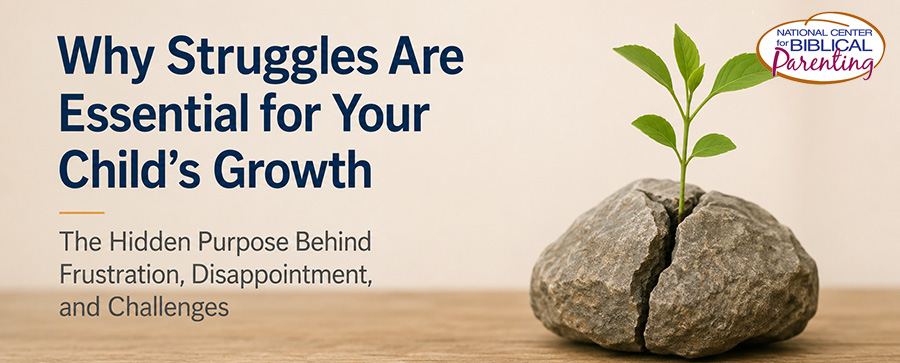
One of the most important truths children can learn is that growth happens through challenges. Muscles grow through resistance, athletes improve through training, and students learn through difficult assignments. Character develops in much the same way.
The Bible describes this process clearly in Romans 5:3-4: “Not only so, but we also glory in our sufferings, because we know that suffering produces perseverance; perseverance, character; and character, hope.” Notice the progression. Difficulties produce perseverance, perseverance develops character, and character creates hope.
God often uses challenges to accomplish something inside a person that comfort alone never could. As parents, we sometimes focus so much on removing the struggle that we miss the growth opportunity hidden within it.
The Problem Isn’t Always the Problem
When children face difficulties, parents often focus on the immediate issue. It may be forgotten homework, conflict with a sibling, a disappointing grade, a lost game, an unwanted chore, or a friendship challenge.
Those situations certainly matter, but often the larger issue isn’t the problem itself. The larger issue is how the child responds to the problem. Two children can face the same disappointment and emerge very differently. One becomes bitter, angry, and defeated, while another learns perseverance, resilience, and problem-solving.
The challenge didn’t determine the outcome. The response did. That’s why character development is so important. Life will always present challenges, so children don’t need a life without problems. They need the skills and character to navigate problems successfully.
David’s Preparation Before Goliath
One of the best biblical examples of this principle is David. Most people remember David for defeating Goliath, but David’s character wasn’t formed on the day he faced the giant.
Long before Goliath appeared, David was learning responsibility while tending sheep. He learned faithfulness in ordinary tasks. He learned courage when lions and bears attacked the flock. He learned to trust God in situations where no one else was watching.
Those smaller challenges prepared him for the larger challenge that would eventually come. The giant didn’t create David’s character. The giant revealed David’s character.
The same principle applies to our children. Today’s struggles are often preparing them for tomorrow’s opportunities. The child who learns perseverance while struggling with schoolwork may someday need that same perseverance in a career. The child who learns self-control during sibling conflicts may someday need that skill in marriage. The child who learns responsibility through chores may someday become a dependable employee, leader, spouse, or parent.
What looks like a small challenge today may be preparing your child for something much bigger later.
Children Are on a Mission
One of the most helpful perspectives parents can give their children is the understanding that they are on a mission. The mission of childhood isn’t simply to avoid mistakes or make life comfortable. The mission is growth.
God is developing responsibility, integrity, courage, compassion, self-control, perseverance, wisdom, and faith. Every challenge becomes an opportunity to practice one or more of these qualities.
When children understand this, they begin viewing life differently. Frustrations become opportunities to learn. Responsibilities become opportunities to grow. Difficulties become opportunities to become stronger on the inside. Instead of asking, “Why is this happening to me?” children begin asking, “What can I learn from this?”
Parents Become Coaches
This perspective changes parenting too. Instead of viewing themselves primarily as problem-solvers, parents begin acting more like coaches.
A coach doesn’t remove every obstacle. A coach helps people grow through obstacles. Instead of immediately asking, “How do I fix this?” parents can begin asking different questions.
“What can my child learn from this?” “What character quality is being developed here?” “How can I help my child respond well?” These questions shift the focus from short-term comfort to long-term growth.
Parents still provide support. They still guide, teach, and encourage. But they also recognize that some lessons can only be learned through experience. Growth often happens when children face manageable challenges and learn how to respond wisely.
The Goal Isn’t Easier Children
Many parents unintentionally pursue a goal of fewer problems. While that sounds appealing, God’s goal is often deeper than that.
The goal isn’t simply easier children. The goal is stronger children. God wants to develop children who can persevere, handle disappointment, solve problems, trust Him, and navigate life with wisdom and character.
Those qualities don’t appear overnight. They develop one challenge at a time. Every responsibility, frustration, disappointment, and struggle becomes part of God’s training program for growth.
Parenting Takeaways
- Growth often happens through challenges, not around them.
- The way children respond to difficulties matters more than the difficulty itself.
- David’s victory over Goliath was built on many smaller victories beforehand.
- Children benefit when they understand they are on a mission of growth.
- Parents serve best when they coach children through challenges instead of rescuing them from every difficulty.
Frequently Asked Questions
Should I let my child struggle?
Not every struggle should be removed. Appropriate challenges help children develop resilience, responsibility, and confidence. Parents can provide support while still allowing children to learn important lessons through experience.
How do I know when to help and when to step back?
A good question is whether your involvement is helping your child grow or simply helping them avoid discomfort. Sometimes growth requires experiencing manageable levels of difficulty while knowing a parent is available for support and guidance.
What if my child gets discouraged easily?
Encourage progress rather than perfection. Remind your child that growth takes time and that mistakes and challenges are often part of the learning process. Help them see setbacks as opportunities to practice perseverance.
How does this connect to internal motivation?
Children develop internal motivation when they begin valuing growth, responsibility, and character for their own sake. Instead of acting only to gain rewards or avoid consequences, they learn to embrace the process of becoming the person God wants them to be.
Conclusion
One of the most powerful truths parents can embrace is that struggles are not necessarily signs that something is wrong. Often they are signs that growth is taking place.
God regularly uses frustration, disappointment, responsibility, and challenges to develop maturity and character. As parents, we have the privilege of helping children see those moments not as obstacles but as opportunities.
When children learn that life’s challenges have purpose, they become more resilient, more responsible, and more prepared for the future God has for them. That’s why struggles, while difficult, are often essential for a child’s growth.
Can you share an illustration from your life or your kids’ lives where struggle has produced something good?
Want to Go Deeper?
If you’d like practical tools for helping children develop perseverance, responsibility, self-control, honesty, and strong character, explore Hero Training Camp at Home. This unique parent-child program helps families understand how everyday challenges become opportunities for growth.
The college-level parenting course equips parents with practical coaching strategies that build internal motivation. The accompanying children’s material helps kids understand that they are on a mission of growth and gives them practical ways to respond well to life’s challenges. Together, they provide a powerful framework for helping children grow into the people God created them to be. Learn more at app.biblicalparenting.org/heroeswebinar











Leave a Reply
Want to join the discussion?Feel free to contribute!