
Moving Beyond the “Parental Prompting” Trap


If you’ve ever felt like you’re repeating yourself all day long, you’re not alone.
Many parents feel trapped in an exhausting cycle of reminders, warnings, and prompts. They remind children to make their beds, finish homework, feed the dog, clean up toys, put dishes away, and complete countless other responsibilities. Some days it can feel as if parenting consists primarily of saying the same things over and over again.
The frustrating part is that many children already know what they’re supposed to do. The issue isn’t usually a lack of information. The issue is that they’ve become dependent on external prompting.
One of the large picture goals of parenting, however, isn’t to create children who need constant reminders. The goal is to help children develop an internal motivation that guides their choices even when no one is watching. That’s where conscience development becomes one of the most important aspects of character training.
The Parental Prompting Trap
Most parents begin reminding their children because it’s effective. A child forgets to brush their teeth, so the parent reminds them. A child leaves a backpack in the middle of the floor, so the parent reminds them. A child forgets a chore, so the parent reminds them again.
At first, this seems reasonable. Young children need guidance and support. The problem develops when reminders become the primary motivation for responsibility.
Over time, some children stop paying attention to responsibilities altogether and begin listening only for their parent’s voice. Instead of noticing what needs to be done, they wait for someone to tell them.
This creates a pattern where the parent becomes increasingly responsible while the child becomes less responsible. Parents end up carrying not only their own responsibilities but many of their child’s as well. And responsibility isn’t truly growing inside the child.
The Goal Is an Internal Prompt
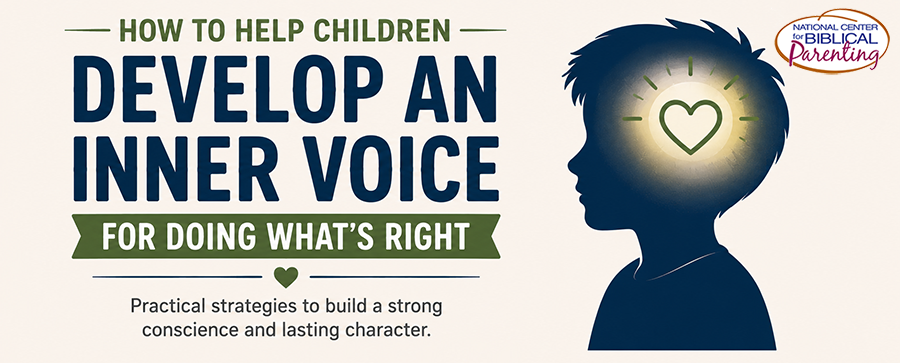
One of the greatest gifts parents can give their children is an internal prompt.
An internal prompt is the voice of responsibility that says, “I need to take care of this,” even when no one else mentions it. It’s the growing conscience that notices unfinished tasks, remembers commitments, and encourages a child to do what’s right.
Children aren’t born with a fully developed internal prompt. It develops gradually through training, coaching, and practice. There are actually two internal prompters. One is the Holy Spirit and the other is the human element God calls the conscience, but it is imperfect and requires training.
Think about how adults manage responsibilities. Most adults don’t wait for someone to remind them to pay bills, show up for work, or complete important commitments. They do those things because they’ve learned to manage themselves. That’s the conscience at work.
Using Environmental Cues Instead of Parent Cues
One practical strategy is helping children learn to respond to environmental cues rather than parental cues.
For example, a child may hear the family dog scratching at the door and recognize that the dog needs to go outside. Another child may notice the clock and realize it’s time to begin homework. A third child may see dirty clothes on the floor and recognize that they belong in the laundry basket.
These environmental cues are powerful because they shift responsibility away from the parent’s voice. Instead of waiting for Mom or Dad to notice the problem, the child begins noticing it themselves.
Parents must parent differently to make this happen. They can encourage this by asking questions such as: “What could remind you?” “What would tell you it’s time?” “What do you see that needs attention?”
These conversations help children develop awareness and ownership.
Every time a child notices a responsibility and acts without being told, they’re strengthening important life skills. They’re learning ownership, initiative, and self-management.
Those qualities eventually influence school performance, work habits, relationships, and future success.
The Difference Between Obedience and Ownership
Obedience is important, but it’s not the final goal. A child can obey while remaining completely dependent on reminders. Ownership goes much deeper. Ownership occurs when children begin valuing the responsibility itself.
For example, a child may initially clean their room because they want to avoid consequences. That’s external motivation.
Later, that same child may keep their room organized because they enjoy being able to find things, appreciate a clean environment, and value order.
That’s ownership. The behavior may look similar on the outside, but the motivation has changed dramatically.
Heart-based parenting focuses on helping children embrace the values behind the actions, not merely the actions themselves.
What This Means for Parents
If you’re feeling stuck in a cycle of constant reminders, don’t lose hope.
The goal isn’t to eliminate reminders overnight. The goal is to gradually transfer responsibility from your voice to your child’s heart. That process happens one responsibility, one conversation, and one success at a time.
Celebrate moments when your child notices something without being told. Point out examples of initiative. Help children connect responsibilities to values. Over time, you’ll begin seeing less dependence on parental prompting and more evidence of genuine ownership.
That’s when responsibility becomes part of who they are rather than simply something they do.
Parenting Takeaways
- Constant reminders can unintentionally create dependence.
- The goal is developing internal motivation, not permanent supervision.
- Environmental cues help children take ownership of responsibilities.
- Ownership is more powerful than simple obedience.
- Responsibility grows best when children understand the value behind the task.
Frequently Asked Questions
At what age should children begin taking responsibility for themselves?
Children can begin learning responsibility at very young ages through simple tasks such as putting away toys, helping with chores, and caring for personal belongings.
How do I stop feeling like I’m nagging?
Shift from repeated reminders to coaching conversations. Help children identify cues and systems that remind them rather than relying exclusively on your voice.
What if my child ignores responsibilities?
Continue providing accountability while gradually helping them take more ownership. Responsibility is learned through practice and repetition.
Is it wrong to remind children?
Not at all. Reminders are often necessary, especially with younger children. The goal is simply to reduce dependence on reminders over time.
Conclusion
One of the most important transitions in parenting is moving children from external prompting to internal responsibility. Children who learn to manage themselves gain skills that will serve them throughout life. While the process takes patience and consistency, the payoff is tremendous. Instead of depending on someone else to tell them what to do, children begin developing the character, initiative, and responsibility to do what’s right on their own.
Want to Go Deeper?
If you’d like practical tools for helping children develop responsibility, initiative, self-control, honesty, and strong character, explore Hero Training Camp at Home. This unique parent-child program helps families move beyond behavior management and focus on heart transformation. The college-level parenting course, for parents of children of all ages, equips parents with practical coaching strategies. The accompanying children’s material focuses the teaching on children ages 3-12 through engaging lessons, object talks, activities, and discussions. Together, they provide a powerful framework for helping children develop an internal sense of responsibility that lasts a lifetime. To learn more go to app.biblicalparenting.org/heroeswebinar






Leave a Reply
Want to join the discussion?Feel free to contribute!