
“I’m Disappointed, But I’ll Be Okay”

One of the most important emotional skills a child can learn is how to handle disappointment well. Every child experiences moments when life doesn’t go the way they hoped. They don’t get what they want. Plans change. Someone says no. A privilege is removed. A friend hurts their feelings. Something feels unfair.
In those moments, many children simply react emotionally. They melt down, argue, pout, complain, or withdraw. Their emotions become so large that they struggle to regain perspective. And if children don’t learn how to manage disappointment in healthy ways early in life, those emotional patterns often continue into adulthood.
That’s why parents must intentionally teach emotional resilience.
One simple phrase can become a powerful emotional tool for children of all ages:
“I’m disappointed, but I’ll be okay.”
Those words are powerful because they do two important things at the same time. First, they acknowledge the emotion honestly. Second, they put the emotion into perspective.
That balance is incredibly important.
Some children grow up thinking emotions should be ignored or pushed away. They may hear responses like:
“Stop crying.”
“You’re fine.”
“It’s not a big deal.”
While parents usually mean well, children can begin believing that emotions themselves are wrong. But disappointment is not wrong. Sadness is not wrong. Frustration is not wrong. These emotions are normal human experiences.
Other children go in the opposite direction. Their emotions become so strong that disappointment completely controls their outlook and behavior. A small frustration becomes a major crisis. A denied request feels devastating. The emotional reaction becomes bigger than the situation itself.
Healthy emotional maturity lies somewhere in the middle.
A child needs to learn how to acknowledge emotions honestly without becoming controlled by them.
That’s exactly why the phrase “I’m disappointed, but I’ll be okay” works so well.
That’s a life skill.
Children who learn this skill become far more emotionally flexible as they grow. They begin to understand:
“I can survive hard moments.”
“I don’t always get what I want.”
“Strong emotions don’t have to control me.”
“I can move through disappointment in healthy ways.”
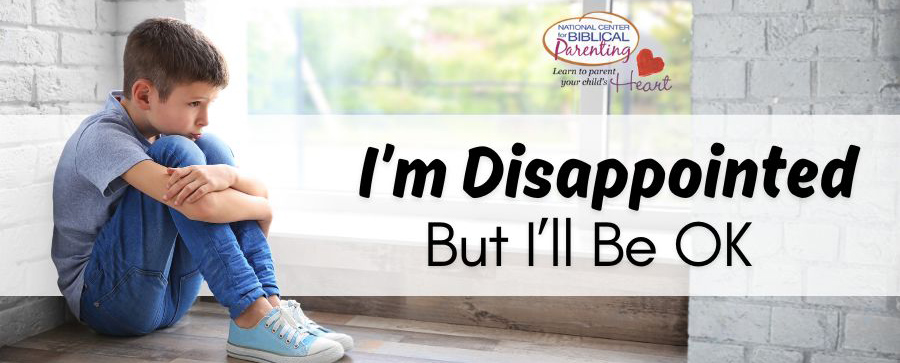
One grandmother used this phrase with her three-year-old granddaughter who would often become upset and go mope in the corner whenever things didn’t go her way. Instead of simply correcting the behavior or trying to distract her, Grandma taught her to repeat these words:
“I’m disappointed, but I’ll be okay.”
Something important happened in the child’s heart. The phrase helped her manage her emotions by acknowledging them without allowing them to define her. That’s the key.
Disappointment is something we experience. It should not become our identity.
Parents can use this phrase in all kinds of everyday situations:
- When a child loses a game
- When plans change
- When they don’t get the toy they wanted
- When they are told no
- When privileges are removed
- When a sibling gets something they don’t
- When a friend disappoints them
- When life feels unfair
Instead of rushing to fix the disappointment or remove the frustration, parents can coach children through it.
That’s an important distinction.
Sometimes parents work so hard to protect children from uncomfortable emotions that they unintentionally weaken emotional resilience. They distract, rescue, negotiate, or reverse decisions simply to avoid emotional reactions.
But children actually grow stronger when they learn how to move through disappointment successfully.
This does not mean parents should become harsh or dismissive. Children still need empathy and connection. A parent can calmly say:
“I know this is disappointing.”
“I understand that you’re upset.”
“This is hard.”
And then help the child practice the new response:
“But you’ll be okay.”
Over time, children begin internalizing this message. Eventually, they start saying it to themselves without prompting. That’s when emotional tools become part of the child’s internal world.
What’s especially powerful about this phrase is that it works for adults too.
Adults experience disappointment constantly. Careers don’t unfold as planned. Relationships become difficult. Financial pressures arise. Health problems appear. Expectations fail. Life often includes loss, frustration, and unmet desires.
Many adults still react emotionally because they never developed healthy emotional processing skills as children.
That’s why this phrase is not just for kids. Those words create emotional steadiness. They remind us that disappointment is part of life, not the end of life. They help us acknowledge pain without becoming consumed by it.
Parents who model this perspective give children a tremendous gift. Children learn emotional resilience not only through instruction but also through observation. When parents handle disappointment calmly, thoughtfully, and with perspective, children begin learning how to do the same.
In many ways, emotional maturity is not about avoiding disappointment. It’s about learning how to walk through disappointment without losing perspective, hope, or stability. That’s a lesson children will use for the rest of their lives.








Leave a Reply
Want to join the discussion?Feel free to contribute!