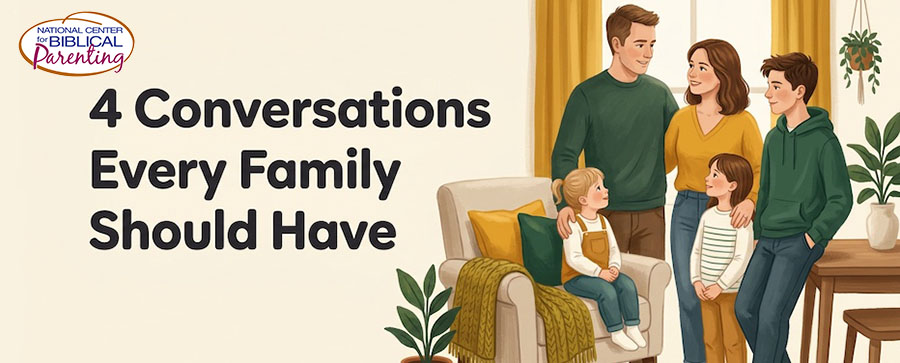
4 Conversations Every Christian Family Should Have

A six-year-old watches the plate of bread pass by without stopping at her seat and asks why. An eleven-year-old. wonders if he should get baptized. A teenager wants to know if showing up on Sunday means anything if nobody there would notice he stopped coming. Three different ages, three different questions about Christianity, and not one of them came with a script.
The Gospel Resources Hub built that script and it’s FREE for families and for churches.
Family Foundations is a set of four guided paths that walk a family through the questions almost every Christian household eventually runs into:
- How can one become a Christian?
- Should I get baptized?
- What is communion?
- What does it look like to belong to a church rather than simply attend one?
Age Appropriate Answers
What makes this program work for a real family is the age structure underneath it. Every one of the four topics is written at four different levels: ages 4 to 6, ages 7 to 10, ages 11 to 14, and a fuller adult guide for whoever is leading the conversation.
A household with kids spread across a decade can sit down on the same night and open the same topic together, and each child meets it at a level that actually fits, instead of one script that’s too simple for the oldest or over the head of the youngest.
Every session follows a similar shape:
- A short passage of Scripture,
- A few guided questions to talk through as a family
- A section written specifically to answer the question a kid at that age is most likely to actually ask, or should be asking as part of their spiritual growth journey.
That last part is where the material earns its keep. Rather than leaving a parent to guess what a nervous eleven-year-old might be thinking, the baptism sessions address the infant baptism question directly, in language written for an eleven-year-old, not a theologian answering a doctrine class. The tone stays honest rather than tidy. When a topic genuinely calls for a real conversation with a pastor instead of a simple answer, the material says so instead of pretending a worksheet can settle it.
A Parent’s Guide to Spiritual Milestones in their Children’s Lives
How to Become a Christian opens the set with four sessions that walk through the full arc of the gospel: you are loved by God, sin is a real and serious problem, Jesus took the punishment in your place, and trusting him starts something entirely new.
It doesn’t rush past the uncomfortable middle. Kids are told plainly that something is wrong, then shown just as plainly what was done about it, rather than being handed a watered-down version that skips from love straight to happy ending.
What Is Baptism? picks up from there with three sessions on what going under the water actually pictures, why it is commanded even though it does not save anyone, and how to prepare for the day itself, including the kind of practical detail a nervous child actually wants to know, like what to expect and what to say.
What Is Communion? runs three sessions on the Lord’s Supper, built around a correction a lot of kids need without knowing it. Communion is something you receive, not something you earn by being good enough that particular week. Left uncorrected, that quiet assumption tends to follow a child straight into adulthood, turning a gift into one more performance to manage.
Belonging to God’s Family closes the set with four sessions on the church itself, working from why people were built for community in the first place through what it actually means to carry each other rather than simply sit near each other on a Sunday morning. It is the difference between a family that attends a church and a family that belongs to one, and the material treats that difference as the entire point rather than a technicality.
For Parents and Church Leaders
None of the four paths asks for a login or a subscription. A family picks an age level, opens a topic, and starts the conversation on their own schedule, before the question ever has a chance to catch anyone off guard at the worst possible moment.
Church leaders get just as much use out of this as parents do. A confirmation class or a new members class already has a built structure to lean on instead of one built from scratch every year. A student preparing for baptism gets a real three-session path instead of a single rushed conversation squeezed in before a service.
And because every age level covers the same ground at a different depth, one topic can be handed to a kindergarten class and a middle school small group in the same week, with both groups getting a version that actually fits where they are.
Kids ask these questions eventually, usually without warning and rarely at a convenient moment. And if they aren’t asking these questions, parents can prompt the spiritual dialogue. Family Foundations exists so that when the question finally lands, the answer is already sitting there, ready, and it fits the child who is asking it.
All four paths are FREE, with nothing to sign up for, and available now at The Gospel Resources Hub. Go here to see it for yourself. https://thegospelresourceshub.org/family-foundations/
Frequently Asked Questions
What are some free Christian resources for teaching kids about salvation, baptism, communion, and church?
Family Foundations is a good place to start. It’s four free guided paths, one each for becoming a Christian, baptism, communion, and belonging to a church, and there’s nothing to sign up for or log into.
How can I explain to my child how to become a Christian?
The How to Become a Christian section of Family Foundations gives parents an age-appropriate way to explain the gospel. It teaches children that God loves them, sin separates people from God, Jesus took the punishment for sin, and a person begins a new life with Christ by trusting in him.
How do I talk to my child about baptism?
Family Foundations includes a three-session What Is Baptism? guide that helps children understand what baptism means, why Jesus commands it, and why baptism doesn’t save a person. It also helps children know what to expect when they’re preparing to be baptized.
How do I explain communion or the Lord’s Supper to a child?
The What Is Communion? section helps parents explain the Lord’s Supper in language children can understand. It teaches that communion points to what Jesus has done for us and is something Christians receive with gratitude rather than something they earn by being good enough.
At what age should I start talking to my child about salvation, baptism, and communion?
Parents can begin these conversations even when children are young. Family Foundations provides separate materials for ages 4–6, ages 7–10, ages 11–14, and adults, allowing parents to discuss the same spiritual truth at a level appropriate for each child’s development.
Is there a Christian discipleship curriculum that works for children of different ages in the same family?
Yes. Family Foundations is specifically structured so that families with children of different ages can study the same topic together. Each subject is presented at several developmental levels, allowing younger children, older children, and parents to participate in the same conversation.
What should I do if my child was baptized as an infant and now has questions about baptism?
Questions about infant baptism can lead to valuable spiritual conversations. The Family Foundations baptism materials address this question directly for older children and encourage families to talk with their pastor when theological or denominational differences need further discussion.
How can Christian parents help their children develop a sense of belonging in the church?
The Belonging to God’s Family section teaches children that church is more than attending a Sunday service. It explores Christian community, relationships, serving others, and what it means to participate in the life of a local church rather than simply showing up.
What are the most important spiritual conversations Christian parents should have with their children?
Four important conversations involve how a person becomes a Christian, what baptism means, what communion means, and what it means to belong to a church. These are significant spiritual milestones that help children understand both their relationship with Christ and their place in the Christian community.
Are there free Christian family discipleship resources I can use at home?
Yes. The Gospel Resources Hub offers the Family Foundations materials free for families. Parents can choose the appropriate age level, read a short Scripture passage, work through guided questions, and discuss important spiritual truths together at their own pace.
Can churches use Family Foundations for children’s ministry, youth ministry, or membership classes?
Yes. Churches can use Family Foundations in baptism preparation, confirmation classes, new member instruction, children’s ministry, youth groups, or conversations with individual students and families. Because the same subjects are available at different age levels, churches can adapt the material for several ministry settings.
Where can I find the free Family Foundations Christian discipleship resources?
Family Foundations is available free from The Gospel Resources Hub. The resource includes age-appropriate guides on becoming a Christian, baptism, communion, and belonging to God’s family.
Explore Family Foundations here:
https://thegospelresourceshub.org/family-foundations/

Leave a Reply
Want to join the discussion?Feel free to contribute!