
How to Move Family Rules from the Refrigerator to Your Child’s Heart
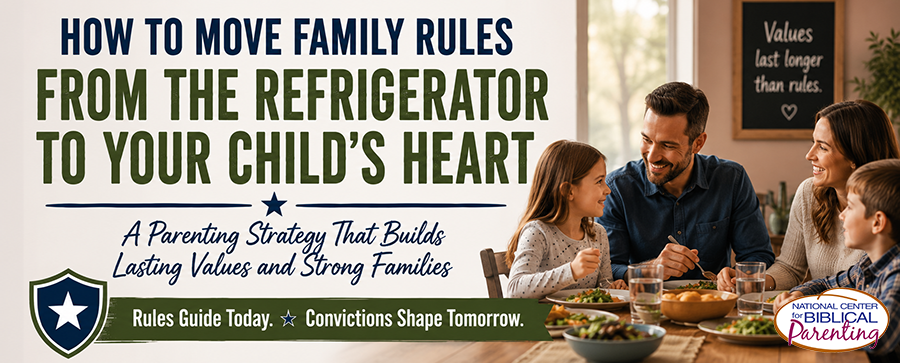

Every family has rules. Some are spoken, some are written, and some are simply understood. We tell children to use kind words, clean up after themselves, come to dinner on time, tell the truth, and respect others. Rules help create order and provide important boundaries for family life. But if parenting stops at rules, children may learn compliance without understanding the deeper values behind those expectations.
The goal of biblical parenting isn’t simply to raise children who follow rules while they’re living at home. The goal is to raise children who develop internal values that guide them long after they’ve left your supervision. Rules can control behavior for a season, but convictions shape behavior for a lifetime. That’s why wise parents use rules as bridges that connect daily behavior to deeper heart values.
When children understand the convictions behind the rules, something powerful begins to happen. The rule gradually moves from the refrigerator to the heart.
Rules Are Most Effective When They Point to a Value
One mistake many parents make is assuming children automatically understand the purpose behind a rule. In reality, children often see rules as random restrictions that limit their freedom. They may obey because they have to, but they don’t necessarily understand why the rule exists.
Consider a family rule that requires everyone to attend dinner together. A child may view that rule as an inconvenience that interrupts playtime, video games, or social activities. If the rule is presented only as a requirement, the child may comply but never appreciate its purpose.
However, when parents explain the conviction behind the rule, everything changes. Parents can explain that mealtime is more than eating food. It’s a time for building relationships, strengthening family connections, sharing experiences, and showing interest in one another’s lives. The rule exists because of a deeper conviction that relationships matter.
This same principle applies to many family rules. Bedtimes may be rooted in the conviction that healthy bodies need rest. Honesty rules may be rooted in the conviction that trust is essential for healthy relationships. Chore expectations may reflect the conviction that family members contribute to the well-being of the household.
Children don’t naturally see these connections. Parents help them discover them.
Explain the “Why” Behind the Rule
Children often ask, “Why?”
Sometimes that question feels like resistance. Other times it’s a genuine opportunity for training.
While parents don’t need to negotiate every family expectation, explaining the reason behind a rule helps children internalize the value it represents. Instead of merely saying, “Because I said so,” parents can help children understand the larger purpose.
For example, if a child is required to complete chores before playing, the deeper conviction isn’t simply about getting work done. It may be the belief that responsibility comes before recreation. That’s a conviction that will benefit a child throughout life.
If a child is expected to speak respectfully, the conviction may be that every person is worthy of honor because they are created in God’s image. That’s far more powerful than simply enforcing a rule about tone of voice.
The more children understand the “why,” the more likely they are to embrace the value rather than merely tolerate the rule. Over time, those values become part of the child’s own belief system.
This is one reason Jesus frequently taught principles rather than merely issuing commands. He wanted people to understand the heart behind obedience, not simply the behavior itself.
Rules May Change, but Convictions Remain
One of the most important lessons parents can learn is that rules are temporary, but convictions are timeless.
As children grow, family rules naturally change. A toddler needs different boundaries than a teenager. A young child may need constant supervision while crossing a parking lot, while an older teenager may be trusted to drive a car. The rules are different because the child’s stage of development is different.
However, the underlying conviction remains the same.
In both cases, the conviction is that life is valuable and should be protected.
The same principle applies throughout parenting. Curfews may change. Screen-time limits may evolve. Levels of independence may increase. Yet the convictions underneath those decisions often remain remarkably stable.
When parents focus primarily on convictions, they’re preparing children for the day when the rules disappear.
Eventually, your child won’t be asking, “What are Mom and Dad’s rules?”
Instead, they’ll be asking, “What do I believe?”
That’s the question convictions answer.
The Power of Three for Younger Children
For parents of younger children, it can sometimes feel overwhelming to address every behavior issue separately. Fortunately, many situations can be simplified into a few foundational categories.
One helpful approach is to focus on three basic expectations:
Obey.
Show respect.
Be kind.
These simple principles cover a surprising number of daily situations. When a child refuses an instruction, the issue is obedience. When a child talks back, the issue is respect. When a child hurts a sibling, the issue is kindness.
Rather than creating dozens of rules, parents can repeatedly reinforce these foundational values. Over time, children begin to understand that these expectations reflect deeper convictions about relationships, authority, and love.
This approach also helps children learn principles rather than merely memorizing regulations.
What This Means for Parents
Parents often spend enormous energy enforcing rules, but the greater opportunity lies in explaining the values behind those rules. Every correction becomes a chance to teach a conviction. Every family expectation becomes an opportunity to shape a child’s heart.
The goal isn’t simply getting children to comply today. The goal is helping them develop internal values that guide them tomorrow.
When parents consistently connect rules to convictions, children gradually move from external compliance to internal ownership. They begin doing what’s right not merely because they’re told to, but because they understand why it matters.
That’s where lasting character development begins.
Parenting Takeaways
- Rules are most effective when connected to deeper values.
- Explain the “why” behind family expectations whenever possible.
- Focus on developing convictions, not merely enforcing compliance.
- Remember that rules change as children grow, but convictions remain.
- Use simple foundational values with younger children: obey, show respect, and be kind.
- View every correction as an opportunity to teach a heart value.
Frequently Asked Questions
Should parents always explain every rule?
Not necessarily. Immediate obedience is sometimes necessary. However, teaching moments later can help children understand the values behind the expectation.
What’s the difference between a rule and a conviction?
A rule is an external guideline. A conviction is an internal belief that motivates behavior from within.
What if my child argues every time I explain a rule?
The goal isn’t debate. The goal is understanding. Parents can explain the value without turning every discussion into a negotiation.
At what age can children begin understanding convictions?
Even young children can grasp simple values such as kindness, honesty, responsibility, and respect when parents explain them in age-appropriate ways.
Conclusion
Family rules serve an important purpose, but they were never meant to be the final destination. They are bridges that help children move from external guidance to internal conviction. As parents consistently explain the values behind the rules, children begin to understand not only what to do, but why it matters. And when those convictions take root in the heart, they become a guide that can last a lifetime.
Want to Go Deeper?
If you’d like practical tools for helping children develop convictions, responsibility, integrity, self-control, and compassion, explore Hero Training Camp at Home. This unique parent-child program helps families move beyond behavior management and focus on heart transformation. The college-level parenting course equips parents with practical strategies, while the children’s activities help bring biblical character principles to life in engaging and memorable ways. Together, they provide a powerful framework for helping children develop the values and convictions they’ll carry throughout their lives.

Leave a Reply
Want to join the discussion?Feel free to contribute!