
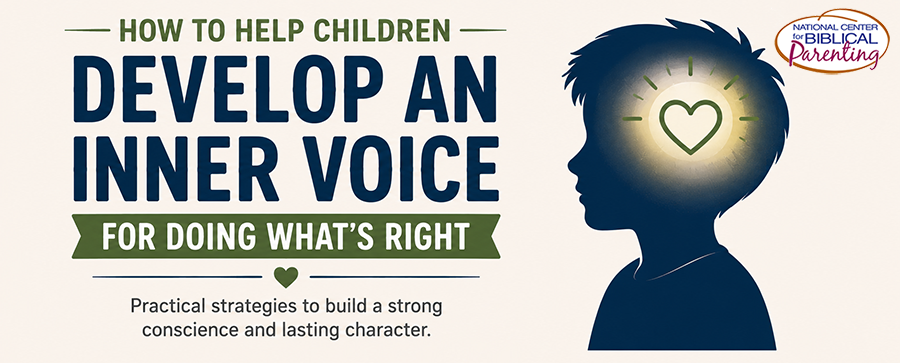
How to Help Children Develop an Inner Strength for Doing What’s Right

One of the greatest goals of parenting is helping children learn to do what’s right without needing constant reminders. Most parents have experienced the frustration of repeating the same instructions day after day. “Did you brush your teeth?” “Did you finish your homework?” “Did you feed the dog?” Sometimes it can feel as though parenting is little more than becoming a professional reminder service.
While reminders are necessary, they aren’t the ultimate goal.
The goal is helping children develop an internal motivation that guides their choices even when parents aren’t present. We want children to do the right thing because they believe it’s right, not merely because someone is watching. That’s where conscience development becomes so important.
A healthy conscience acts like an internal guide. It helps children recognize what’s right, feel satisfaction when they choose it, and experience discomfort when they don’t. The good news is that parents can actively strengthen this internal voice through intentional coaching and practical strategies at home. It’s especially powerful when the Holy Spirit is activated in a child’s life as well.
Focus on the Heart, Not Just the Behavior
Many parents unintentionally focus most of their attention on external behavior. “Good job cleaning your room.” “Thank you for doing your homework.” “I’m proud of you for obeying.”
Those statements aren’t wrong. In fact, encouragement is important. However, if parents only affirm the external action, children may miss the deeper lesson. The heart motivation is often more important than the behavior itself.
Imagine a child who tells the truth even though it results in consequences. Rather than simply saying, “Thank you for being honest,” a parent might add, “Doesn’t it feel good to tell the truth even when it’s hard?” That question shifts attention inward.
The child begins reflecting on the internal reward of honesty rather than simply receiving external praise. Over time, children start recognizing that doing what’s right brings its own sense of satisfaction.
This kind of coaching helps strengthen the conscience because it draws attention to internal motivation rather than external performance.
Strengthen the Instruction Cycle
One practical way to build responsibility and conscience awareness is through what might be called the instruction cycle. Many parents give instructions and then immediately move on to something else.
“Clean your room.” “Take out the trash.” “Feed the dog.” The child may hear the instruction—or may not.
Instead, try strengthening the process. First, give the instruction. Second, require the child to answer back so you know the instruction was heard and understood. Third, have the child complete the task. Finally, require the child to report back when finished.
This simple cycle creates ownership. Instead of the parent constantly chasing the child for completion, the child learns responsibility for communicating progress. Reporting back becomes part of the assignment.
Over time, children begin recognizing that responsibility includes both completing the task and communicating about it. That’s an important life skill.
The Power of “You’re Free to Go”
One of the most overlooked phrases in parenting is, “You’re free to go.” After a child reports back, the parent can inspect the work, acknowledge the effort, and then release the child with those simple words.
At first glance, this may seem insignificant. In reality, it creates a powerful emotional experience. Children often wonder, “Did I do enough?” “Is there something else?” “Am I finished?”
When parents clearly release them, children experience relief, accomplishment, and closure. The task is complete. The responsibility has been fulfilled. The conscience receives confirmation that the job was done well.
This process creates a stronger connection between responsibility and satisfaction. Children begin experiencing the reward of completing a task rather than merely escaping a parent’s reminders. That’s a subtle but important shift.
Modeling Integrity at Home
One of the most powerful tools for conscience development isn’t found in a parenting technique at all. It’s found in the parent’s example. Children learn a tremendous amount by watching how adults handle their own weaknesses, failures, and mistakes.
Parents sometimes assume they must appear perfect in order to maintain credibility. In reality, children often learn more from honest humility than from apparent perfection.
When parents admit mistakes, apologize sincerely, and acknowledge their own need for growth, they demonstrate integrity in action.
A parent might say, “I lost my patience today, and that wasn’t right.” “I should have handled that differently.” “I’m working on growing in this area too.” These statements communicate something powerful. They show children that character growth is a lifelong process.
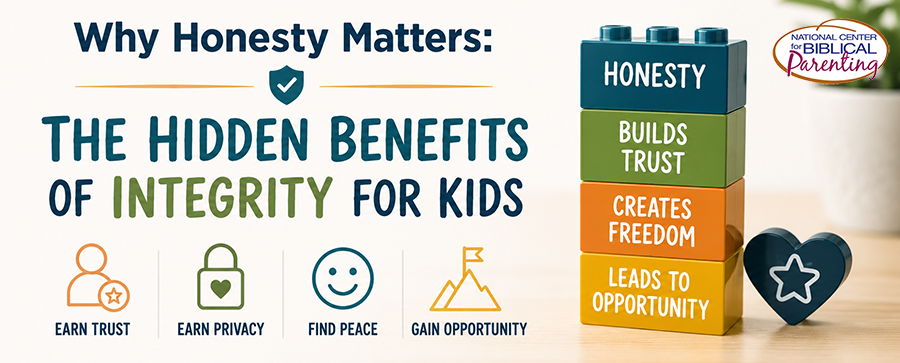
They also demonstrate that strong people aren’t those who never fail. Strong people are those who respond honestly when they do. Modeling integrity creates an atmosphere where children feel safe telling the truth because they see truthfulness practiced regularly at home.
It’s What’s on the Inside that Counts
Many parents focus on controlling behavior. Conscience training focuses on developing character. That’s an important distinction. And it prepares a child for the deeper work of the Holy Spirit.
Behavior can be controlled through supervision. Character guides behavior when supervision is absent.
The goal isn’t raising children who merely comply with rules. The goal is raising children who possess an internal desire to do what’s right because they value honesty, responsibility, kindness, and integrity.
Those qualities become part of who they are. A strong person isn’t someone who performs dramatic acts of courage. He or she is someone who consistently chooses what’s right, even when nobody is watching. That kind of strength develops one decision at a time.
What This Means for Parents
Conscience development doesn’t happen overnight. It grows through thousands of conversations, examples, instructions, corrections, and encouragements. Parents who focus on the heart, strengthen responsibility, provide closure, and model integrity are building something that will last long after childhood ends.
The real goal of parenting isn’t simply getting children to obey. The goal is helping them develop an inner strength that guides them toward wisdom, responsibility, and godly character for the rest of their lives.
Parenting Takeaways
- Affirm internal motivation, not just external behavior.
- Help children recognize the satisfaction that comes from doing right.
- Strengthen responsibility through the instruction cycle.
- Require children to report back after completing assignments.
- Use “You’re free to go” to create closure and accomplishment.
- Model integrity by admitting mistakes and pursuing growth.
Frequently Asked Questions
How do I know if my child is developing internal motivation?
You’ll notice increasing initiative, responsibility, honesty, and a willingness to do the right thing without constant reminders.
Should I still praise good behavior?
Yes. Just make sure to connect the behavior to the internal qualities that produced it.
What if my child forgets to report back?
Treat reporting back as part of the assignment. Consistency helps build responsibility. Common words are, “The job isn’t done until you report back.”
Why is modeling so important?
Children often learn more from what parents do than from what parents say. Integrity is most effectively taught through example.
Conclusion
Every parent hopes their child will eventually learn to make wise decisions independently. That process begins by helping children develop a strong conscience and an internal desire to do what’s right. As parents intentionally affirm heart motivations, strengthen responsibility, provide clear closure, and model integrity, they help children build an inner strength that will guide them throughout life. This involves both the conscience and the Holy Spirit’s work. That’s one of the greatest gifts a parent can give.
Want to Go Deeper?
To learn more about developing internal motivation in children, consider the parent-child interactive program Hero Training Camp at Home. This unique program includes a college-level parenting course with eight sessions focused on helping children develop responsibility, integrity, compassion, and other character qualities from the inside out.
In addition to the parent training, the program includes activities, Bible stories, craft ideas, and conversation starters designed for children ages 3–12. While the children’s activities focus on younger kids, the parenting course is valuable for parents of children of all ages. If you’re looking for practical ways to build character, strengthen the conscience, and help your child develop internal motivation, Hero Training Camp at Home provides a powerful next step. Learn more at https://app.biblicalparenting.org/heroesathome


Leave a Reply
Want to join the discussion?Feel free to contribute!