
How to Help Children Manage Big Emotions Without Ignoring Their Values
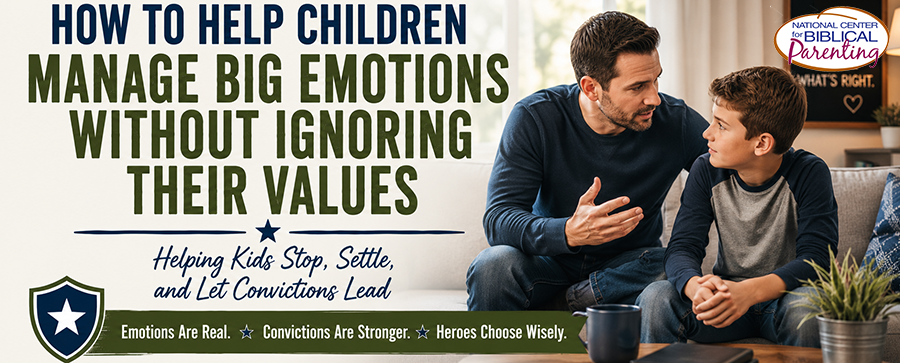

Every parent has seen it happen. A child who knows the right thing to do suddenly makes a poor choice because emotions take over. A sibling says something hurtful, and anger explodes. A friend gets picked for the team, and jealousy surfaces. A difficult assignment feels overwhelming, and frustration turns into tears or avoidance. In those moments, it can seem as though the child’s conscience, values, and common sense have completely disappeared.
The reality is that emotions are powerful. God created them for a purpose, and they can be wonderful gifts. Joy helps us celebrate. Compassion moves us to care for others. Excitement creates anticipation. Fear can alert us to danger. But emotions can also become dangerous when they overpower convictions and take control of decision-making.
One of the most important skills parents can teach is how to recognize strong emotions without allowing those emotions to become the boss. Children need to learn that emotions are real and important, but they aren’t always reliable guides. Convictions, grounded in truth, must remain in the driver’s seat.
When Emotions Hijack the Conscience
Most children don’t make their worst decisions because they don’t know what’s right. More often, they make poor choices because strong emotions temporarily overpower what they know.
Think about a child who becomes angry with a sibling. Before the conflict, that child would probably agree that hitting is wrong. They might even teach the rule to someone else. But in the heat of the moment, anger can become so intense that the conviction gets pushed aside.
The same thing happens with fear, jealousy, embarrassment, disappointment, and frustration. These emotions aren’t inherently sinful, but they can become enemies of wise decision-making when children allow them to bypass their thinking and control their responses.
That’s why parents should avoid treating emotional outbursts as simply behavior problems. The deeper issue is often that emotions have overwhelmed convictions.
When children understand this concept, they begin to see that the battle isn’t just about controlling behavior. The battle is about learning how to let truth remain stronger than feelings.
The Power of Stop and Settle
One of the most practical skills children can learn is what we call “Stop and Settle.”
When emotions begin rising, most children naturally want to push forward. They want to keep arguing, keep talking, keep defending themselves, or keep reacting. Unfortunately, that’s often the worst possible strategy.
Heroes learn something different.
They learn to pull back.
Imagine driving a car down a steep hill. If the driver notices the vehicle picking up too much speed, continuing to accelerate would be dangerous. The wise response is to slow down and regain control.
The same principle applies emotionally.
When children recognize that anger, frustration, or fear is escalating, they need permission and training to stop and settle. That might involve taking a few deep breaths, stepping away from the conflict, sitting quietly for a few minutes, or simply pausing before responding.
Parents can model this skill by saying things like:
“I think your emotions are getting bigger than your thinking right now.”
“Let’s stop and settle before we continue.”
“Let’s give your heart a chance to calm down.”
These simple phrases teach children that slowing down isn’t weakness. It’s wisdom.
Helping Convictions Win the Battle
Once children learn to stop and settle, they’re ready for the next step: reconnecting with their convictions.
One helpful coaching strategy is what we might call an “Emotion-to-Conviction Drill.”
Suppose a child says:
“I’m too tired to do my homework.”
That statement reflects an emotion.
Rather than arguing, a parent can help the child identify a conviction that applies to the situation.
The conversation might sound like this:
“What’s a conviction that could help you here?”
The child may eventually identify something like:
“I should finish my responsibilities before I play.”
Or:
“Doing hard things helps me grow.”
The goal isn’t to dismiss the emotion. The child may genuinely be tired. The goal is to help the child recognize that emotions don’t get the final vote.
The same approach works with many situations.
Emotion:
“It’s not fair.”
Conviction:
“I can respond with respect even when I don’t like the outcome.”
Emotion:
“I want to get even.”
Conviction:
“God wants me to forgive.”
Emotion:
“I’m afraid I’ll fail.”
Conviction:
“I can trust God and do my best.”
Over time, children begin developing the habit of comparing feelings with truth. That’s a skill that will serve them throughout life.
Measuring Progress, Not Perfection
One mistake parents often make is expecting emotional growth to happen instantly. In reality, emotional maturity develops gradually.
A helpful way to evaluate progress is by looking at three areas.
First, is the frequency decreasing? Are emotional outbursts happening less often?
Second, is the intensity decreasing? When emotions do cross the line, are the reactions becoming less explosive?
Third, is recovery becoming faster? Does the child settle down more quickly than before?
These are often the real indicators of growth.
The goal isn’t raising children who never experience strong emotions. The goal is raising children who increasingly know how to manage them.
Every step toward self-control is a victory worth celebrating.
What This Means for Parents
Children don’t need parents who eliminate emotions. They need parents who teach them how to navigate emotions wisely.
That means helping children recognize feelings without being controlled by them. It means teaching them to stop and settle before reacting. It means helping them reconnect with biblical convictions when emotions are pulling them in another direction.
Most importantly, it means reminding children that feelings make wonderful passengers but terrible drivers.
When convictions remain in charge, children develop the wisdom, self-control, and maturity they’ll need throughout their lives.
Parenting Takeaways
- Emotions are real, but they shouldn’t control decisions.
- Strong emotions often cause children to bypass convictions.
- Teach children to stop and settle before reacting.
- Help children identify convictions that apply to emotional situations.
- Measure progress by frequency, intensity, and recovery time.
- Celebrate growth rather than demanding perfection.
Frequently Asked Questions
Are emotions bad?
No. God created emotions, and they serve important purposes. The problem occurs when emotions control decisions instead of convictions.
What age can children learn Stop and Settle?
Even young children can begin learning simple calming strategies and pausing before reacting. The skill becomes more refined as they grow.
Should I talk to my child during an emotional outburst?
Usually it’s best to focus on helping the child calm down first. Teaching is much more effective after emotions have settled.
How do convictions help emotional regulation?
Convictions provide truth-based guidance when emotions are pulling children toward impulsive responses. They help children choose what is right instead of simply reacting.
Conclusion
Every child experiences anger, fear, frustration, jealousy, and disappointment. Those emotions aren’t the problem. The challenge is helping children learn how to respond wisely when emotions become intense. As parents teach children to stop and settle, reconnect with convictions, and evaluate situations through the lens of truth, they help build a foundation of emotional maturity that will serve them for years to come.
Want to Go Deeper?
If you’d like practical tools for helping children develop self-control, emotional maturity, responsibility, integrity, and strong convictions, explore Hero Training Camp at Home. This unique parent-child program helps families move beyond behavior management and focus on heart transformation.
The college-level parenting course equips parents with practical coaching strategies, while the children’s activities help bring these lessons to life in engaging and memorable ways. Together, they provide a powerful framework for helping children develop the character and convictions they’ll carry into adulthood.








Leave a Reply
Want to join the discussion?Feel free to contribute!