
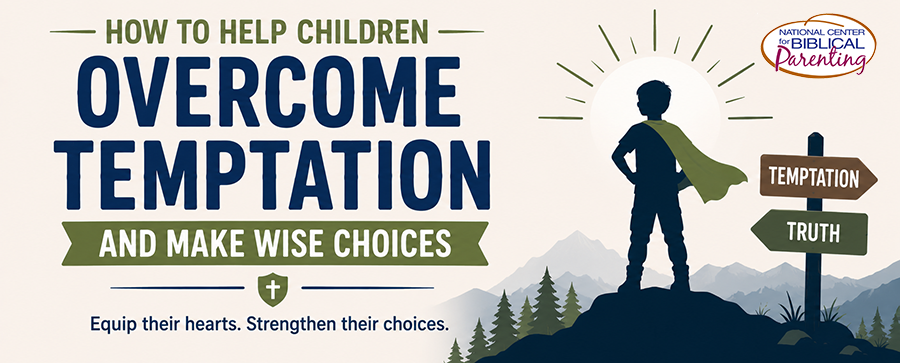
How to Help Children Overcome Temptation and Make Wise Choices

Every parent wants their child to make good choices. We want children to tell the truth when lying would be easier, show kindness when they’re angry, and do what’s right even when nobody is watching. Yet every parent also knows that children face temptations every day.
Some temptations seem small.
A child is tempted to blame a sibling.
A student is tempted to copy someone else’s work.
A teenager is tempted to fit in with friends by compromising values.
Other temptations carry much greater consequences.
Regardless of the situation, temptation is one of the greatest challenges children face because it targets the heart before it ever affects behavior.
That’s why helping children overcome temptation requires more than rules and consequences. It requires teaching them how to win the battle inside before the battle ever appears on the outside.
The good news is that God has provided everything children need to grow stronger, wiser, and more capable of making good choices.
Understanding the Real Battle
Many parents focus on what children do.
God often focuses on why they do it.
Temptation begins long before an action occurs. It usually starts when an outside situation connects with an inside desire.
A child wants something.
A child feels something.
A child fears something.
A child becomes frustrated by something.
Then an opportunity appears.
That combination creates temptation.
For example, a child may desperately want approval from friends. When friends encourage poor choices, the temptation becomes stronger because it connects with an internal desire to belong.
Or a child may feel angry after being treated unfairly. The temptation to seek revenge becomes powerful because it connects with an internal desire for justice.
The battle isn’t primarily external.
It’s internal.
That’s why lasting change requires helping children understand their hearts. If they learn to recognize temptation early, they’re much more likely to make wise decisions when pressure arrives.
David’s Greatest Victory Wasn’t With a Sword
When people think about David, they usually think about Goliath.
Yet one of David’s greatest victories happened long after the giant was defeated.
In 1 Samuel 25, David encountered a wealthy and foolish man named Nabal. David and his men had protected Nabal’s shepherds and property, but when David requested assistance, Nabal responded with insults and disrespect.
David became furious.
In fact, he was ready to take revenge.
At that moment, David faced a powerful temptation.
He had the ability to retaliate.
He had the opportunity to retaliate.
He certainly felt justified in retaliating.
Yet through the wise intervention of Abigail, David stepped back from his anger and chose a different path.
That’s what made him a hero.
His greatest victory wasn’t defeating an external enemy.
It was defeating an internal one.
David chose to maintain a clear conscience rather than satisfy his desire for revenge.
Children face similar moments every day. Their temptations may not involve armies or kings, but they often involve the same internal struggles with anger, selfishness, pride, fear, or dishonesty.
The lesson remains the same.
Real heroes win the battle inside first.
Developing the Binocular Principle
One of the best ways to help children overcome temptation is teaching them to recognize it before it arrives.
Think about binoculars.
Binoculars allow people to see things from a distance before those things become immediate problems.
Wise children learn to do the same thing.
They begin asking questions such as:
“What situations make it harder for me to tell the truth?”
“What friendships encourage poor choices?”
“What circumstances usually lead me into trouble?”
This kind of awareness is incredibly valuable.
Many poor decisions happen because temptation catches people by surprise. They don’t recognize the danger until they’re already standing in the middle of it.
Heroes learn to see temptation coming.
They develop spiritual binoculars.
Rather than waiting until temptation is directly in front of them, they recognize patterns, identify weaknesses, and make wise decisions in advance.
This skill becomes increasingly important as children grow older and gain more independence.
God Always Provides a Way Forward
One of the most encouraging verses parents can teach children is 1 Corinthians 10:13:
“No temptation has overtaken you except what is common to mankind. And God is faithful; he will not let you be tempted beyond what you can bear. But when you are tempted, he will also provide a way out so that you can endure it.” (NIV)
Many people focus on the phrase “way out.”
They imagine God always removing the temptation.
Sometimes He does.
But often the “way out” is actually the strength to stand firm and make a wise choice despite the temptation.
That’s an important distinction.
Children need to understand that courage doesn’t always mean escaping difficulty. Sometimes courage means staying in the situation and doing what’s right anyway.
God’s promise is not that temptation will disappear.
His promise is that He will provide what is needed to overcome it.
That’s incredibly hopeful because it means children are never facing temptation alone.
God is actively helping them succeed.
Building Strong Hearts Through Practice
No one becomes strong by accident.
Athletes develop strength through training.
Musicians develop skill through practice.
Children develop character through repeated opportunities to make good choices.
Each time a child tells the truth under pressure, honesty grows stronger.
Each time a child controls anger, self-control grows stronger.
Each time a child chooses kindness, compassion grows stronger.
The goal isn’t perfection.
The goal is progress.
Parents should celebrate these victories because every wise choice strengthens the heart for future challenges.
Over time, children begin seeing themselves differently.
They begin recognizing that they can overcome temptation.
They begin believing that character matters.
And they begin developing the confidence that comes from repeated success.
What This Means for Parents
Temptation isn’t something to fear.
It’s something to prepare for.
Every temptation creates an opportunity for growth.
As parents help children understand their hearts, recognize temptation early, learn from biblical examples, and trust God’s strength, they equip them for challenges they’ll face throughout life.
The goal isn’t raising children who never experience temptation.
The goal is raising children who know how to respond when temptation comes.
That’s how heroes are made.
Parenting Takeaways
- Temptation begins in the heart before it affects behavior.
- Help children identify internal desires that influence choices.
- David’s victory over revenge teaches the importance of a clear conscience.
- Use the Binocular Principle to help children recognize temptation early.
- Teach 1 Corinthians 10:13 as a source of hope and confidence.
- Character grows stronger through repeated wise choices.
Frequently Asked Questions
Is temptation itself a sin?
No. Temptation is not sin. Jesus was tempted, yet He never sinned. The issue is how we respond to temptation.
How can I help my child recognize temptation earlier?
Discuss patterns, situations, friendships, and circumstances that often lead to poor choices. Encourage self-awareness and reflection.
What if my child keeps making the same mistake?
Focus on growth rather than perfection. Help them identify triggers, develop strategies, and continue practicing better responses.
Why is David’s story important for children?
It shows that true strength isn’t just physical power. Real strength is choosing what’s right when emotions push us toward something wrong.
Conclusion
Every child will face temptation. The question isn’t whether temptation will come but whether children will be prepared when it does. As parents teach children to recognize internal battles, learn from biblical examples, anticipate challenges, and depend on God’s strength, they help build the kind of character that lasts a lifetime. That’s how children learn to make wise choices, maintain a clear conscience, and become heroes in training.
Want to Go Deeper?
If you’d like practical tools for helping children develop honesty, self-control, courage, integrity, and a strong conscience, explore Hero Training Camp at Home. This unique parent-child program helps families move beyond behavior management and focus on heart transformation. The college-level parenting course equips parents with practical coaching strategies, while the children’s activities bring biblical character principles to life through engaging lessons, object talks, activities, and discussions. Together, they provide a powerful framework for helping children overcome temptation and develop lasting character.









Leave a Reply
Want to join the discussion?Feel free to contribute!