
How to Stop Family Conflict and Become a Positive Influence at Home

Every family has a certain amount of emotional energy. You can feel it when you walk into a home. Some homes seem peaceful, encouraging, and enjoyable to be part of. Other homes feel tense, draining, and exhausting. The difference often isn’t the size of the home, the amount of money a family has, or even the number of problems they’re facing. More often, the difference comes from the way family members contribute to—or drain—the emotional energy of the household.
Parents spend a great deal of time helping children learn responsibility, obedience, and self-control. Those lessons matter. But there’s another important question that children need to learn to ask themselves: “Am I making life better or harder for the people around me?” When children begin thinking this way, they move beyond simple rule-following and start developing relational maturity.
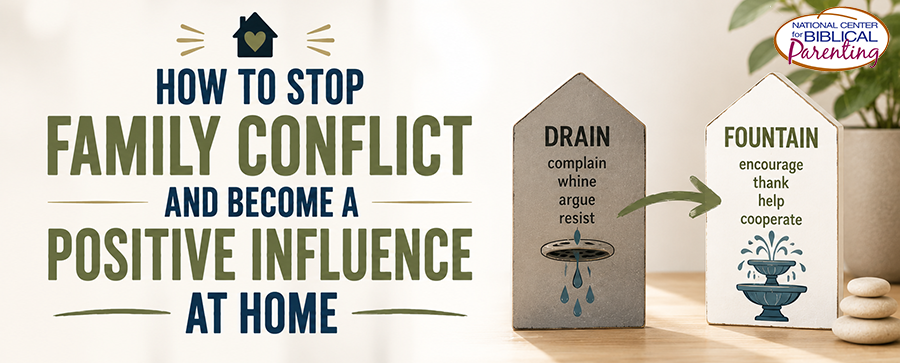
One of the most helpful ways to understand this concept is through the picture of a drain and a fountain.
Every Family Has an Emotional Energy Tank
Imagine that every family starts the day with a large tank of water representing emotional energy. Throughout the day, everyone draws from that tank.
Normal responsibilities naturally use some energy. Parents go to work. Children complete school assignments. Meals need to be prepared. Laundry has to be folded. Appointments must be kept. These everyday responsibilities require effort, but they are a normal part of life.
The real problem occurs when dishonoring attitudes begin draining the tank at a much faster rate.
Complaining drains energy.
Whining drains energy.
Arguing drains energy.
Resisting instructions drains energy.
Constant negativity drains energy.
Many parents have experienced a day when one child’s attitude seemed to affect the entire family. The actual issue may have been small, but the emotional drain created by the response was enormous. Before long, everyone feels tired, frustrated, and discouraged.
Children often don’t realize the impact their attitudes have on the people around them. They may think they’re simply expressing feelings. In reality, they’re influencing the emotional climate of the entire home.
Helping children understand this principle can be life-changing because it shifts the focus from individual desires to relational impact.
Are You a Drain or a Fountain?
The opposite of a drain is a fountain.
While drains remove energy, fountains add energy.
Think about the people you enjoy being around most. Chances are they make life better. They encourage others. They express gratitude. They cooperate. They notice needs and help meet them. They bring positive energy into relationships.
That’s what fountains do.
Honor is often what transforms a drain into a fountain.
A child who says, “Thank you for dinner,” adds energy.
A child who helps a sibling without being asked adds energy.
A child who completes a responsibility with a good attitude adds energy.
A child who notices a parent is tired and offers assistance adds energy.
These actions may seem small, but they have a powerful cumulative effect on family culture.
Over time, fountains create homes where people feel valued, appreciated, and encouraged.
One of the most practical questions parents can ask children is:
“Right now, are you being a drain or a fountain?”
The question encourages self-awareness without immediately turning the conversation into a lecture.
The Secret to Stopping Arguments
Many family arguments continue because parents focus on the issue instead of the process.
Imagine a child demanding a snack.
The natural temptation is to discuss the snack.
Should they have it?
Is it too close to dinner?
Have they eaten something healthy already?
While those questions may be valid, they often miss the bigger issue.
The real problem may not be the snack at all.
The real problem may be the way the child is speaking.
If the child is whining, demanding, arguing, or becoming disrespectful, the conversation has shifted from the issue to the process.
Wise parents learn to address the process first.
They might say:
“We can talk about the snack later. Right now, we need to talk about how you’re talking to me.”
This approach changes everything.
Instead of rewarding dishonoring communication with extended debate, parents teach children that relationships matter more than winning an argument.
Over time, children begin to understand that getting what they want is less important than maintaining healthy interactions.
That’s a lesson that will benefit them for the rest of their lives.
Creating a Fountain Culture
One of the most effective ways to build a positive family culture is by encouraging intentional acts of kindness.
Children often assume kindness should happen only when someone deserves it or asks for it. But some of the most powerful acts of kindness are unexpected.
Challenge children to perform secret acts of kindness.
Perhaps they make a sibling’s bed.
Maybe they leave an encouraging note.
Perhaps they help with a chore without announcing it.
These small actions help children shift their focus away from themselves and toward others.
What’s fascinating is that kindness often creates momentum. One act inspires another. Gratitude becomes contagious. Cooperation spreads.
Before long, the emotional climate of the home begins to change.
Families become healthier when everyone starts looking for ways to add energy instead of taking it away.
What This Means for Parents
Children don’t automatically understand how their attitudes affect other people. They need coaching and practice.
By helping children recognize draining behaviors and encouraging fountain behaviors, parents teach one of life’s most important relational skills. Children learn that their words, attitudes, and actions influence everyone around them.
That’s a powerful lesson because it develops empathy, honor, and responsibility all at the same time.
The goal isn’t raising children who never have bad days.
The goal is raising children who increasingly understand how to contribute positively to the people around them.
Parenting Takeaways
- Every family has a limited amount of emotional energy.
- Complaining, whining, and arguing drain that energy quickly.
- Encouragement, gratitude, and cooperation add energy.
- Focus on the process of communication, not just the issue being discussed.
- Ask children whether they’re being a drain or a fountain.
- Encourage secret acts of kindness that build positive family culture.
Frequently Asked Questions
What if my child complains constantly?
Instead of arguing about the complaint itself, help your child recognize how complaining affects the people around them and the emotional atmosphere of the home.
Is it wrong for children to express negative feelings?
No. Children need to express emotions honestly. The goal is helping them do so respectfully and constructively.
How do I teach kindness without forcing it?
Model it consistently, notice it when it happens naturally, and create opportunities for children to practice it through service and encouragement.
What is a fountain behavior?
A fountain behavior is any action that adds positive energy to relationships, such as gratitude, cooperation, encouragement, helpfulness, or kindness.
Conclusion
Every child has the ability to influence the atmosphere of the home. Some behaviors drain emotional energy, while others add it. When children learn to become fountains instead of drains, they contribute to healthier relationships, stronger family connections, and a more positive environment for everyone. That’s a skill that will benefit them not only at home but throughout their entire lives.
Want to Go Deeper?
If you’d like practical tools for helping children develop honor, kindness, initiative, self-control, and strong relational skills, explore Hero Training Camp at Home. This unique parent-child program helps families move beyond behavior management and focus on heart transformation.
This college-level parenting course equips parents with practical coaching strategies, while the children’s activities help bring biblical character principles to life through engaging lessons, object talks, activities, and discussions. Together, they provide a powerful framework for helping children become positive influences in their homes, friendships, and future relationships.







Leave a Reply
Want to join the discussion?Feel free to contribute!