
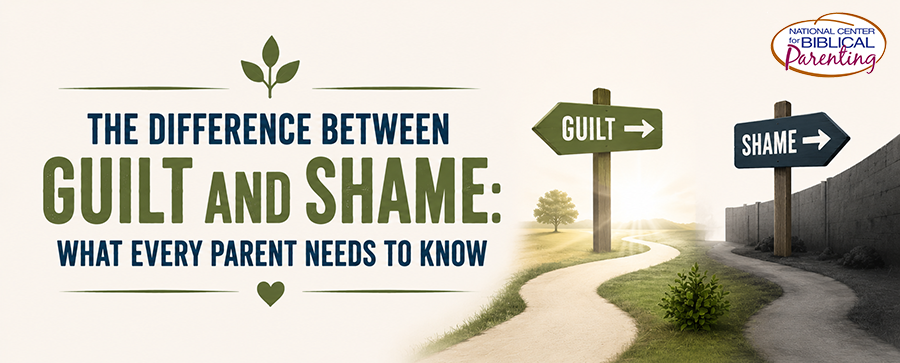
The Difference Between Guilt and Shame: What Every Parent Needs to Know

Many parents struggle with what to do after a child has made a mistake. Whether it’s lying, disobedience, unkindness, or poor choices, parents naturally want children to understand the seriousness of their actions. We want them to learn responsibility, make things right, and grow in character. Yet in the process of correcting behavior, it’s possible to unintentionally communicate a message that damages rather than develops a child’s heart.
The key is understanding the difference between guilt and shame.
Although many people use those words interchangeably, they are very different experiences. One is a healthy tool God designed to help people grow. The other can become a heavy burden that leaves children feeling defeated and hopeless. When parents understand the difference, they can help children develop a clear conscience without damaging their sense of identity and worth.
This distinction may be one of the most important emotional and spiritual lessons a child ever learns.
Why Guilt Isn’t Always Bad
In today’s culture, guilt often gets a bad reputation. People frequently talk about “guilt trips” or “feeling guilty” as though guilt is automatically unhealthy. Yet the Bible presents a different picture.
Guilt is actually one of God’s tools for helping people recognize wrongdoing and move toward restoration.
Think about physical pain for a moment. Pain isn’t pleasant, but it serves an important purpose. If you touch a hot stove, pain alerts you to danger and motivates you to pull your hand away. Without pain, serious injury could occur.
Guilt functions similarly in the heart.
When children do something wrong, guilt creates discomfort. That discomfort isn’t intended to punish them. It’s designed to motivate them to make things right. It prompts confession, repentance, restitution, and reconciliation.
In that sense, guilt serves as a spiritual warning light.
The discomfort continues until the problem is addressed.
That’s why healthy guilt can actually be a gift. It motivates children to take responsibility and seek restoration instead of ignoring problems or pretending they don’t exist.
The Difference Between Guilt and Shame
The distinction between guilt and shame can be summarized in a simple way.
Guilt says:
“I did something wrong.”
Shame says:
“I am something wrong.”
Guilt focuses on behavior.
Shame focuses on identity.
That’s a critical difference.
A child who experiences healthy guilt understands that a poor choice was made and that the choice needs to be corrected. The child still believes growth is possible. The child still believes mistakes can be repaired.
Shame sends a very different message.
Shame tells children that their failure defines them. Instead of seeing a mistake as something they did, they begin seeing it as who they are.
Rather than thinking, “I lied,” they begin thinking, “I’m a liar.”
Rather than thinking, “I made a poor choice,” they begin thinking, “I’m a bad kid.”
This shift is dangerous because shame doesn’t motivate change. It often produces discouragement, withdrawal, defensiveness, or hopelessness.
Children who carry shame frequently feel trapped because they no longer see a pathway forward.
That’s why guilt can motivate growth while shame often cripples it.
How Parents Accidentally Create Shame
Most parents don’t intend to shame their children. In fact, many loving parents unintentionally drift into shaming language because they’re frustrated, exhausted, or overwhelmed.
When emotions are high, it’s easy to move from addressing behavior to attacking character.
Statements like:
“What’s wrong with you?”
“You never learn.”
“Why are you always like this?”
“You’re impossible.”
may communicate shame even when parents don’t intend them that way.
Children often internalize those messages far more deeply than parents realize.
Wise correction focuses on the behavior rather than attacking the child’s identity.
Instead of saying:
“You’re so selfish.”
A parent might say:
“That choice was selfish.”
Instead of saying:
“You’re dishonest.”
A parent might say:
“You didn’t tell the truth.”
One addresses who the child is.
The other addresses what the child did.
That distinction protects the child’s identity while still addressing the offense.
Helping Children Pursue a Clear Conscience
One of the healthiest goals parents can teach is the pursuit of a clear conscience.
A clear conscience isn’t achieved by pretending mistakes never happened. It’s achieved by addressing mistakes honestly and completely.
When children confess wrongdoing, seek forgiveness, make restitution when necessary, and choose a different path moving forward, the burden of guilt is lifted.
That’s why guilt should be viewed as a temporary motivator, not a permanent condition.
Its purpose is to prompt action.
Once the offense has been addressed, children need freedom to move forward.
Many children continue carrying emotional burdens long after forgiveness has been offered because they don’t understand this process. They believe they should keep feeling bad as proof that they’re sorry.
But that’s not how God’s grace works.
God doesn’t call us to carry guilt forever. He calls us to respond to it appropriately and then walk forward in freedom.
Parents can reinforce this truth by helping children focus not only on what they did wrong but also on what they can do right next time.
That’s where growth occurs.
What This Means for Parents
Every correction moment communicates something about identity.
Children need to know that mistakes matter, but they also need to know that mistakes don’t define them.
When parents use guilt appropriately, they help children recognize wrongdoing and pursue restoration. When parents avoid shame, they preserve hope and create an environment where growth remains possible.
The goal isn’t simply helping children feel bad about wrongdoing.
The goal is helping them develop the courage to face mistakes honestly, make things right, and move forward with a clear conscience.
That’s a lesson they’ll need for the rest of their lives.
Parenting Takeaways
- Guilt focuses on behavior; shame focuses on identity.
- Healthy guilt motivates confession and restoration.
- Shame often produces discouragement and helplessness.
- Correct behavior without attacking the child’s character.
- Help children pursue a clear conscience rather than ongoing self-condemnation.
- Emphasize growth, responsibility, and hope.
Frequently Asked Questions
Is guilt always unhealthy?
No. Healthy guilt is a God-given prompt that helps people recognize wrongdoing and seek restoration.
How can I tell if my child is experiencing shame?
Children experiencing shame often make statements like “I’m a bad kid,” “I never do anything right,” or “Everyone is disappointed in me.”
Should children feel bad when they do something wrong?
Temporary discomfort is normal and healthy. The goal is for that discomfort to motivate positive action, not create a permanent negative self-image.
What’s the best way to correct without shaming?
Focus on the behavior, explain why it was wrong, help the child make things right, and affirm the child’s ability to grow and change.
Conclusion
Every child will make mistakes. That’s part of growing up. The question isn’t whether children will fail but how they will learn to respond when they do. Healthy guilt points children toward responsibility, repentance, and restoration. Shame, on the other hand, convinces them that failure defines who they are. As parents learn to distinguish between the two, they create an environment where children can develop both a tender conscience and a strong sense of hope. That’s a powerful combination for lifelong growth.
Want to Go Deeper?
If you’d like practical tools for helping children develop responsibility, honesty, emotional health, self-control, and a clear conscience, explore Hero Training Camp at Home. This unique parent-child program helps families move beyond behavior management and focus on heart transformation. The college-level parenting course equips parents with practical coaching strategies, while the children’s activities help bring biblical character principles to life through engaging lessons, object talks, activities, and discussions. Together, they provide a powerful framework for helping children grow through mistakes and develop the confidence that comes from a clear conscience before God and others.









Leave a Reply
Want to join the discussion?Feel free to contribute!